
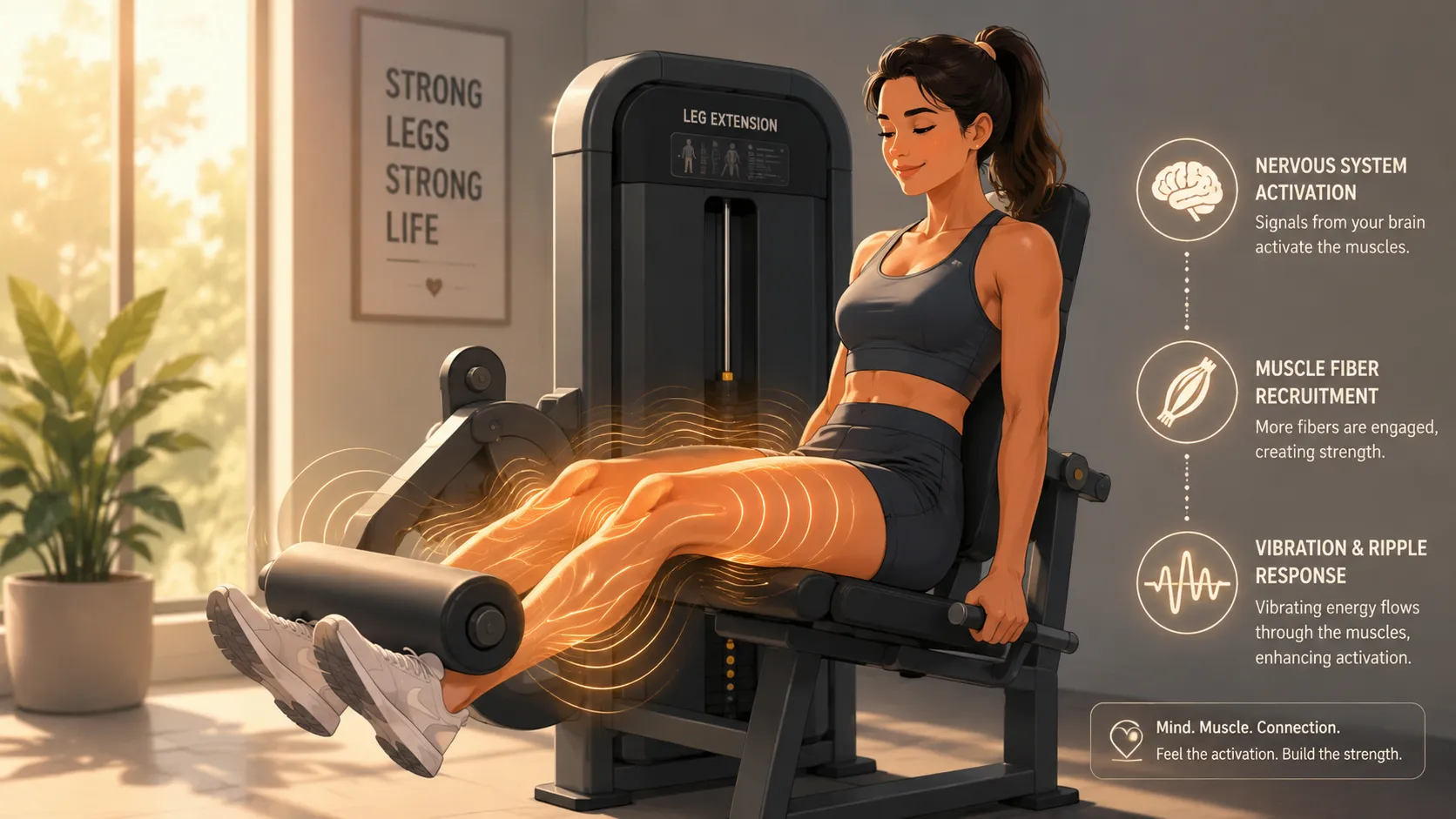
Recent exercise science research shows that muscle shaking during resistance exercises is most commonly linked to neuromuscular fatigue, increased motor unit recruitment, and reduced force control as muscles tire. Studies examining knee extensors and quadriceps muscles have found that force fluctuations increase during fatigue and that the nervous system recruits additional motor units to maintain force output when muscles become exhausted. Researchers also note that both the nervous system and the muscle itself contribute to declining force production during demanding exercise.
Why Do Your Legs Shake on Leg Extensions?
Understanding Leg Shaking During Leg Extensions
Leg extensions look deceptively simple. You sit down, extend your knees, squeeze your quadriceps, and lower the weight back under control. Yet many people are surprised when their legs begin trembling halfway through a set, especially near the top of the movement. The shaking can be mild, almost like a vibration, or so noticeable that it feels as though the entire machine is rattling. For some lifters, this happens only during challenging sets. For others, it appears even when the weight seems relatively light.
The reason leg extensions often expose shaking more than other lower-body exercises is that they isolate the quadriceps. Unlike squats, lunges, or leg presses, where multiple muscle groups share the workload, the leg extension places a tremendous demand on the knee extensors. There is less opportunity for stronger muscles elsewhere to compensate. As a result, weaknesses, fatigue, coordination deficits, and stability issues become much easier to notice. Think of it like shining a spotlight on a single actor in a theater production. Every movement, strength, and flaw becomes more visible because there are no supporting performers to hide behind.
Shaking by itself is not automatically a sign that something is wrong. In many cases, it is simply evidence that the nervous system is working hard to coordinate muscle contractions under load. The key is understanding what type of shaking you are experiencing and whether it reflects normal training stress or something that deserves closer attention.
Why the Movement Feels Different From Other Quad Exercises
Leg extensions create high tension in the quadriceps, especially near full knee extension. This position challenges the muscles’ ability to generate force while maintaining stability around the knee joint. Because the exercise isolates the movement pattern, even small coordination issues become obvious. Someone who performs heavy squats comfortably may still experience shaking on leg extensions because the exercise demands a different type of muscular control.
Research on muscle fatigue shows that force production becomes increasingly unstable as muscles tire. These force fluctuations can manifest as visible shaking, especially during isolated movements where fewer muscles can assist.
What Muscle Shaking Usually Means During Leg Extensions
The Connection Between Neuromuscular Fatigue and Trembling
The most common explanation for shaking during leg extensions is neuromuscular fatigue. This term refers to a reduction in the body’s ability to generate force effectively. As a set becomes challenging, the communication between the nervous system and the working muscles becomes less efficient. Your body still attempts to produce the required force, but it does so with increasing difficulty.
Imagine trying to maintain a perfectly steady grip on a heavy object for several minutes. At first, your hand remains stable. As fatigue accumulates, tiny tremors begin to appear. The same principle applies to your quadriceps during leg extensions. The muscles are fighting to maintain force output, but fatigue introduces small variations in contraction strength. These variations become visible as shaking.
Research examining fatigue in knee extensor muscles has found that both the nervous system and the muscle fibers themselves contribute to reduced force production during demanding exercise. As fatigue develops, maintaining smooth movement becomes increasingly difficult.
How Motor Unit Recruitment Creates Visible Shaking
Your muscles are controlled by structures known as motor units, which consist of a motor neuron and the muscle fibers it activates. When a movement begins, your body recruits enough motor units to perform the task. As fatigue increases, additional motor units are recruited to compensate and maintain force output.
Studies on muscle fatigue have shown that motor unit firing rates increase and additional motor units are recruited as fatigue progresses. While this strategy helps maintain performance, it can also contribute to fluctuations in force production. These fluctuations often appear as trembling or shaking during exercise. Think of an orchestra attempting to stay synchronized during a difficult musical passage. The more complex the piece becomes, the harder it is for every musician to remain perfectly coordinated. Similarly, when your nervous system recruits more motor units under fatigue, maintaining perfectly smooth contractions becomes increasingly challenging.
Fatigue, Muscle Recruitment, and Loss of Stability Explained
Why Fatigued Muscles Struggle to Produce Smooth Force
One of the fascinating aspects of human movement is that muscles rarely produce perfectly steady force. Even under ideal circumstances, tiny fluctuations occur continuously. As fatigue develops, these fluctuations become larger and more noticeable.
Researchers studying force control have found that muscle fatigue increases variability in force output. This means the quadriceps are no longer producing a perfectly consistent level of tension. Instead, force rises and falls slightly from moment to moment. The result is visible shaking, particularly during the lowering phase of the leg extension where control demands are high. This explains why many people notice shaking near the end of a set rather than at the beginning. Early repetitions are performed with fresh muscles and efficient coordination. Later repetitions require significantly more effort to maintain the same movement quality. The body compensates as best it can, but some instability inevitably appears.
The Difference Between Productive Fatigue and Excessive Fatigue
Not all fatigue is problematic. In fact, productive fatigue is often part of effective strength training. Challenging the muscles forces adaptation, encouraging improvements in strength, endurance, and muscle growth. Mild to moderate shaking near the end of a difficult set is often simply a sign that the muscles are being challenged appropriately.
Excessive fatigue, however, presents differently. If shaking begins immediately with very light loads, worsens dramatically over time, or persists long after training sessions, it may indicate insufficient recovery, accumulated fatigue, or underlying weakness. The context matters. A slight tremor during the final repetitions of a hard set is very different from uncontrolled shaking throughout an entire workout.
When Shaking Signals Weakness in the Quads or Surrounding Muscles
Quad Weakness Versus Stabilizer Weakness
Sometimes shaking reflects a simple strength deficit. The quadriceps may not yet possess the force-producing capacity required to handle the chosen resistance smoothly. This is especially common among beginners, individuals returning after a break, or athletes recovering from injury.
Weakness is not always isolated to the quadriceps themselves. Supporting muscles surrounding the hips and knees contribute to overall stability. If these muscles are underdeveloped, the body may struggle to maintain smooth movement mechanics even when the quadriceps are relatively strong.
The situation is similar to building a skyscraper on an unstable foundation. The structure may appear strong, but without adequate support, stability problems emerge under stress. The same concept applies to human movement. Stable hips and knees allow the quadriceps to generate force more effectively.
Muscle Imbalances and Their Effect on Knee Extension
Muscle imbalances can also contribute to shaking. If one side of the quadriceps is significantly stronger than another, or if the hamstrings and glutes are not providing balanced support, the nervous system must work harder to coordinate movement.
These imbalances do not always cause pain. In many cases, shaking serves as the first visible clue that force is not being distributed efficiently. Over time, targeted strengthening of weaker muscle groups can improve movement quality and reduce excessive trembling.
The Role of Weight Selection and Exercise Tempo
Using Too Much Weight
One of the most overlooked causes of shaking during leg extensions is simply using more weight than can be controlled properly. Many lifters assume that if they can move the weight from point A to point B, the load is appropriate. Control tells a different story.
When resistance exceeds your current capacity, the nervous system recruits every available resource to complete the movement. This often produces visible shaking, particularly near full extension where leverage becomes less favorable. While occasional challenging sets are useful, consistently training with weights that compromise technique can increase joint stress and limit long-term progress.
The following table highlights how load selection can influence movement quality:
| Weight Level | Typical Outcome |
|---|---|
| Very Light | Minimal fatigue, little shaking |
| Moderate | Controlled movement with mild fatigue |
| Challenging | Some shaking near final repetitions |
| Excessive | Significant shaking and loss of control |
Why Slow Repetitions Often Expose Weaknesses
Many lifters notice more shaking when performing slow repetitions. This isn’t necessarily a bad sign. Slower tempos increase the time muscles spend under tension, making it harder to hide weaknesses through momentum.
A controlled three-to-four-second lowering phase forces the quadriceps to maintain continuous tension. Any deficits in strength, endurance, or coordination become more apparent. In this sense, slow-tempo training acts like a diagnostic tool. It reveals weaknesses that might remain hidden during faster repetitions.
Could Tight Hip Flexors or Poor Mobility Be Contributing?
Hip Position and Quadriceps Mechanics
Mobility plays a larger role in leg extensions than many people realize. The quadriceps cross both the hip and knee joints. Tight hip flexors can alter pelvic positioning, which may influence how efficiently the quadriceps generate force during exercise.
When hip mobility is restricted, the body often compensates through altered movement patterns. These compensations may not always be visible, but they can increase the demand placed on certain muscle fibers. The result may be earlier fatigue and more pronounced shaking.
Imagine trying to pull a rope while standing on uneven ground. The task becomes harder, not because the rope changed, but because your position became less stable. Restricted mobility creates a similar challenge for the muscular system.
Mobility Restrictions That Affect Leg Extensions
Several mobility limitations can contribute to instability during leg extensions:
- Tight hip flexors
- Limited hip extension
- Restricted ankle mobility
- Reduced quadriceps flexibility
- Poor pelvic control
Addressing these issues through stretching, mobility drills, and movement practice often improves exercise quality. While mobility alone may not eliminate shaking, it can reduce unnecessary stress and improve force transfer throughout the movement.
Signs That Shaking May Point to Overtraining or Joint Stress
Warning Signs Beyond Normal Fatigue
Occasional shaking during hard training sessions is usually normal. Persistent shaking combined with declining performance deserves closer attention. Overtraining and inadequate recovery can impair neuromuscular function, making muscles less responsive and less capable of producing smooth force.
Potential warning signs include:
- Persistent fatigue between workouts
- Declining strength levels
- Poor sleep quality
- Prolonged soreness
- Reduced motivation to train
- Shaking occurring earlier in workouts
Research shows that neuromuscular fatigue can originate from both central nervous system factors and changes within the muscle itself. When recovery is inadequate, these factors accumulate and can affect performance across multiple training sessions.
When Knee Discomfort Requires Attention
Shaking alone is rarely concerning. Shaking accompanied by pain is a different matter. Sharp knee pain, swelling, locking, or instability should not be ignored. These symptoms may indicate joint irritation, tendon issues, or other conditions requiring professional evaluation.
A useful rule of thumb is simple: fatigue-related shaking tends to improve with rest and recovery, while injury-related symptoms often persist or worsen regardless of recovery efforts.
Simple Adjustments That Can Improve Control and Stability
Practical Technique Fixes
If leg shaking is limiting your performance, small adjustments can make a significant difference. Begin by reducing the weight slightly and focusing on movement quality. A smoother repetition performed with moderate resistance is generally more productive than a shaky repetition performed with excessive load.
Pay attention to your seating position. Ensure the machine is adjusted correctly so the knee joint aligns with the machine’s pivot point. Improper setup can create unnecessary stress and make maintaining control more difficult.
Breathing also matters. Many lifters unintentionally hold their breath throughout a set, increasing tension and reducing movement efficiency. Controlled breathing helps maintain stability and improve coordination.
Strength and Mobility Strategies for Long-Term Improvement
Long-term improvement requires more than technique adjustments. Strengthening the quadriceps through progressive overload remains essential, but supporting muscles should not be neglected. Exercises such as split squats, step-ups, Romanian deadlifts, and glute bridges can enhance overall lower-body stability.
Mobility work should complement strength training rather than replace it. Consistent stretching of the hip flexors, quadriceps, and surrounding musculature can improve positioning and movement efficiency over time.
The most effective approach combines several strategies:
- Use manageable resistance.
- Prioritize controlled tempo.
- Strengthen supporting muscles.
- Improve mobility restrictions.
- Allow adequate recovery between sessions.
- Monitor signs of excessive fatigue.

Marlon Keene is a 27-year-old American content creator living in Spokane, Washington. Passionate about evidence-based fitness education, he has built experience writing accessible guides for beginners and experienced athletes alike. As an author for muscleprogress.xyz, he combines careful fact-checking with engaging storytelling to produce reliable articles that help readers improve their fitness knowledge and confidence.