
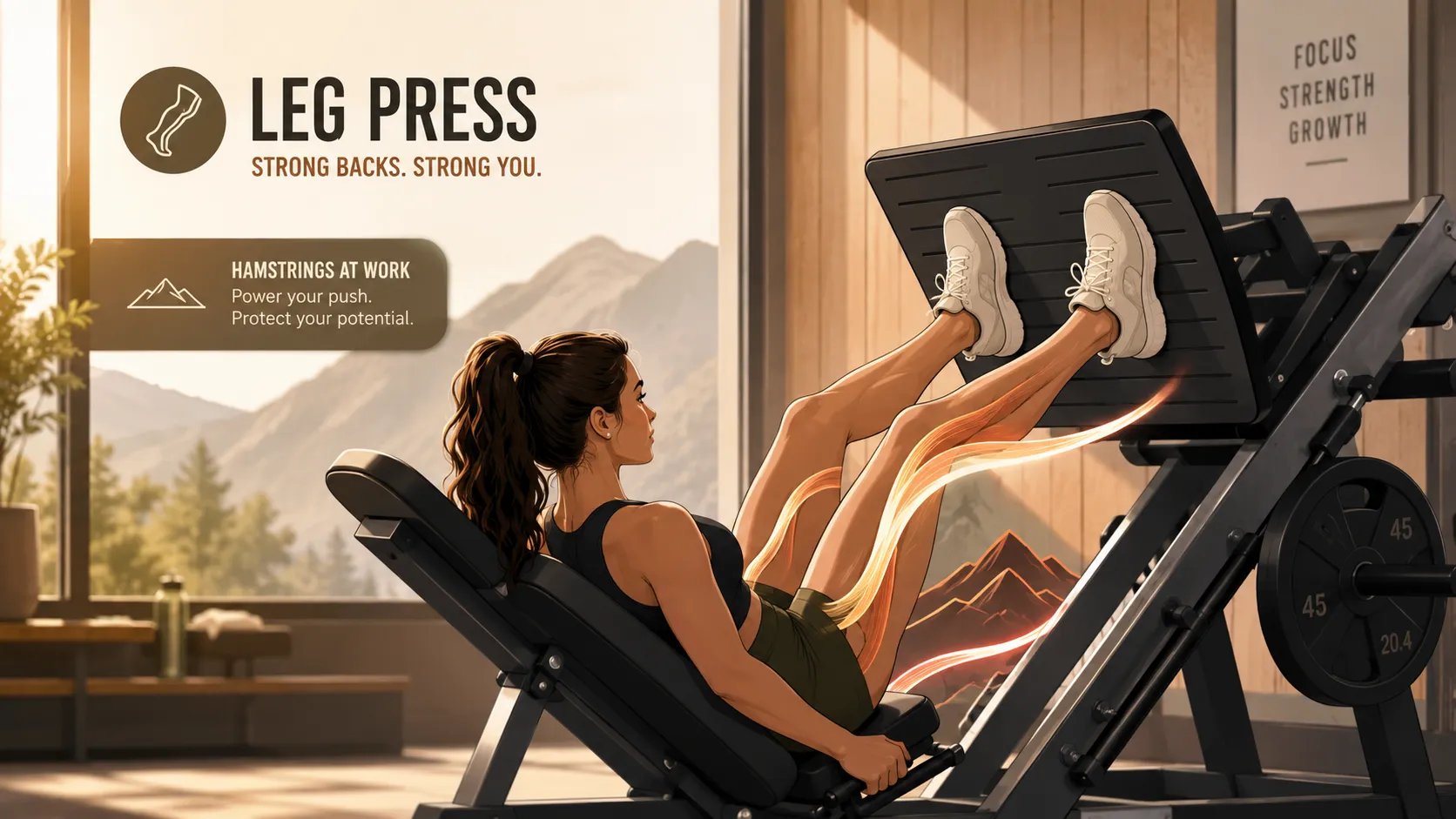
The leg press is often viewed as a quad-building machine, and for good reason. Most lifters step onto the machine, place their feet somewhere in the middle of the platform, and push heavy weight without giving much thought to muscle recruitment. The result? Their quadriceps take over almost entirely while the hamstrings contribute only minimally. Yet with a few strategic adjustments, the leg press can become a much more balanced lower-body exercise that increases posterior chain involvement.
Many gym-goers assume that simply moving their feet higher on the platform instantly transforms the leg press into a hamstring exercise. Reality is a bit more complicated. The hamstrings are not prime movers during the traditional leg press because their primary functions are knee flexion and hip extension. Since the leg press mainly involves knee extension, the quadriceps naturally dominate the movement. Research examining muscle activation patterns consistently shows that quadriceps muscles display the highest activity during leg press variations. That does not mean hamstrings are irrelevant. Proper foot placement, seat position, depth, and tempo can significantly increase their contribution. Think of the hamstrings as supporting actors rather than the lead role. You may never turn the leg press into a pure hamstring exercise, but you can absolutely make the posterior chain work harder. Understanding how each setup variable affects biomechanics is the key to getting more from every rep and creating stronger, more balanced legs.
Understanding the Role of the Hamstrings During the Leg Press
Why the Leg Press Is Naturally Quad-Dominant
The reason the leg press heavily favors the quadriceps comes down to anatomy and mechanics. During the movement, the knees extend against resistance, which is precisely the primary function of the quadriceps. The hamstrings, on the other hand, are responsible mainly for knee flexion and assisting with hip extension. Because the movement pattern does not directly challenge those actions to the same degree, hamstring activation remains secondary.
A systematic review of electromyographic studies found that the quadriceps consistently produced the greatest activation during leg press exercises across multiple variations and intensities. This is why many people feel a burning sensation in the front of their thighs long before they notice any fatigue in the back of their legs.
The mistake many lifters make is expecting the leg press to replace exercises such as Romanian deadlifts or leg curls. That’s like expecting a rowing machine to build the chest as effectively as a bench press. Every exercise has a primary purpose. The leg press excels at loading the lower body safely while emphasizing the quadriceps. Any hamstring involvement comes from modifying the movement to shift more stress toward the hips and posterior chain.
Can the Hamstrings Be Targeted Effectively?
The answer is yes; but only to a point. Research suggests that higher foot placement can increase hamstring and glute involvement compared with some traditional setups. The increased hip flexion created by a higher foot position changes joint angles and encourages greater posterior chain participation.
This doesn’t mean your hamstrings suddenly become the prime movers. Rather, they contribute more to stabilizing and assisting the movement. If your goal is balanced leg development, increasing hamstring participation through setup modifications is worthwhile. If your goal is maximum hamstring growth, additional hamstring-specific exercises remain essential.
Foot Placement Changes That Increase Hamstring Involvement
High Foot Placement on the Platform
Among all leg press adjustments, high foot placement is probably the most effective for increasing hamstring involvement. Positioning the feet higher on the platform creates greater hip flexion during the descent. This places the hamstrings under more stretch and encourages them to assist throughout the movement. Research and biomechanical analyses consistently suggest that higher foot placement tends to increase posterior chain contribution compared to lower placements. Imagine the difference between sitting upright and bending deeply at the hips. The more the hips flex, the more the muscles on the back side of the body become involved. A higher foot position naturally encourages this pattern. Many lifters immediately notice increased tension in the glutes and upper hamstrings when making this adjustment.
One important caution is mobility. Moving the feet too high can cause the pelvis to roll backward at the bottom of the movement. When that happens, the lower back rounds, increasing stress on the lumbar spine. The ideal position is high enough to encourage hip involvement while still allowing the lower back to stay firmly against the pad.
Wide vs. Narrow Stance
A wider stance is commonly recommended for targeting the posterior chain. While research on stance width shows mixed results regarding muscle activation differences, many lifters report feeling greater glute and hamstring engagement when combining a wider stance with higher foot placement. The wider stance allows the hips to move through a slightly different range of motion. This often creates a deeper stretch in the adductors and posterior chain while reducing some of the emphasis placed on the quadriceps. Think of it as redistributing workload rather than completely changing the movement.
The best approach is experimentation. Some individuals feel stronger hamstring engagement with a moderately wide stance, while others notice little difference. Comfort, mobility, and limb proportions all play a role.
Heel Pressure and Foot Angle
One overlooked factor is how force is applied through the foot. Lifters who drive primarily through their toes often increase knee dominance and quadriceps involvement. Driving through the heels encourages greater hip contribution and may help recruit more posterior chain musculature. Community experience and coaching recommendations frequently emphasize maintaining heel pressure throughout the set. Slight external rotation of the feet can also help some individuals achieve better hip mechanics. The goal isn’t an exaggerated duck-foot position but a natural angle that allows comfortable knee tracking. Small adjustments here can create noticeable differences in how the movement feels.
Why Seat Position Affects Muscle Recruitment
Hip Flexion and Hamstring Length
Seat position is rarely discussed, yet it dramatically affects muscle recruitment. Moving the seat closer increases hip flexion at the bottom of the movement. This lengthens the hamstrings and places them in a position where they can contribute more effectively.
Think of a rubber band. A slightly stretched band stores more potential energy than a completely relaxed one. The hamstrings behave similarly. When placed under greater stretch through hip flexion, they become more involved in stabilizing and assisting movement.
Recent research examining backrest inclination and seat positioning found that changes in body position can significantly influence lower-body muscle activation patterns during the leg press. This reinforces the idea that setup matters just as much as foot placement.
Finding the Optimal Seat Distance
There is no universal seat setting that works for everyone. Limb length, hip mobility, and machine design all influence the ideal position. The best setup allows deep knee and hip flexion without causing the pelvis to lift off the pad.
A practical test is simple. Lower the sled slowly until your knees approach your chest. If your lower back begins to round or your hips shift, you’ve exceeded your safe range. Adjust the seat accordingly. The sweet spot is where you feel a substantial stretch through the posterior chain while maintaining spinal stability.
Controlling the Lowering Phase for Better Posterior Chain Activation
The Importance of Eccentric Control
Most lifters focus entirely on pressing the weight up. The lowering phase receives little attention, yet it may be one of the most valuable parts of the exercise. During the eccentric phase, the hamstrings help stabilize the hips and control the descent.
A controlled lowering phase increases time under tension and prevents momentum from taking over. Instead of dropping the sled quickly, aim for a deliberate descent lasting two to four seconds. This forces the muscles to remain engaged throughout the movement rather than relying on passive structures.
Research examining leg press muscle activity has shown meaningful differences in activation patterns during various movement phases. The takeaway is simple: slowing down the negative phase creates more muscular work and often enhances mind-muscle connection.
Tempo Recommendations for Growth
For maximizing posterior chain involvement, a tempo such as:
| Phase | Duration |
|---|---|
| Lowering | 3-4 seconds |
| Pause at bottom | 1 second |
| Press upward | 1-2 seconds |
| Lockout | Minimal pause |
works exceptionally well.
This tempo removes momentum from the equation. The hamstrings remain active longer, and the entire lower body experiences greater tension. Heavy weight alone is not the answer. Controlled execution often produces better results than simply stacking more plates onto the machine.
The Range of Motion Most People Get Wrong
Partial Reps and Lost Tension
One of the most common mistakes in gyms worldwide is performing shallow leg press repetitions. The sled moves a few inches, the plates rattle, and the set ends with little meaningful muscle stimulation. Partial reps dramatically reduce hip flexion and eliminate much of the posterior chain’s contribution.
A deeper range of motion increases the stretch placed on the hamstrings and glutes. This stretch creates mechanical tension, one of the primary drivers of muscle growth. Limiting depth removes a large portion of that benefit.
The key is not chasing extreme depth. The goal is reaching the deepest position that can be achieved safely while maintaining spinal alignment. For most lifters, this means bringing the knees significantly toward the chest without allowing the pelvis to tilt.
Safe Depth Without Lower Back Rounding
Lower back rounding, often called “butt wink” on the leg press, occurs when the pelvis rotates under the body at the bottom position. This usually happens because of poor mobility, excessive depth, or inappropriate foot placement.
The solution is not avoiding depth entirely. Instead, find the point where your lower back remains firmly connected to the seat. That position represents your functional range of motion. Working consistently within that range allows you to challenge the posterior chain safely while reducing injury risk.
Common Leg Press Habits That Shift Tension to the Quads
Low Foot Placement
Low foot placement increases knee travel and quadriceps dominance. While useful for building quads, it is counterproductive when trying to emphasize hamstrings. Research and coaching observations consistently associate lower foot positions with greater quadriceps involvement.
Locking Out Aggressively
Explosive lockouts reduce continuous muscular tension. When the knees snap into extension, some of the load transfers away from the muscles and onto passive joint structures. Keeping a slight bend in the knees maintains tension where it belongs.
Bouncing at the Bottom
Bouncing turns the stretch reflex into the primary source of force. While it may allow heavier loads, it decreases muscular control and reduces the quality of the stimulus. Smooth transitions are far more effective for posterior chain recruitment.
Pairing Leg Press With Other Hamstring-Focused Exercises
Romanian Deadlifts
If the leg press is the supporting actor, the Romanian deadlift is often the leading role for hamstring development. This exercise directly loads the hamstrings through hip extension while placing them under substantial stretch.
The combination works beautifully. Leg press provides high-volume lower-body work, while Romanian deadlifts deliver targeted hamstring overload.
Seated and Lying Leg Curls
Leg curls train the hamstrings through their primary function: knee flexion. They complement the leg press perfectly because they address a movement pattern that the leg press largely misses.
Many lifters experience the best hamstring growth when combining both exercises within the same training week. One movement emphasizes knee flexion, while the other provides compound lower-body loading.
Glute Bridges and Hip Thrusts
Glute bridges and hip thrusts strengthen the entire posterior chain while minimizing lower back stress. They also teach proper hip extension mechanics, which can improve performance on the leg press.
A balanced lower-body program often includes all three categories:
- Compound press movement
- Hip hinge movement
- Knee flexion movement
Together they create comprehensive development rather than leaving weak links behind.
Signs Your Hamstrings Are Actually Doing the Work
Sensations During the Set
Many lifters rely entirely on muscle soreness as feedback, but that’s not always reliable. During a well-executed hamstring-focused leg press, you may notice:
- A stretch in the upper hamstrings during the descent
- Increased tension behind the thighs
- Greater glute engagement at the bottom
- Reduced quadriceps dominance

Corbin Winslow is a 29-year-old American content writer and fitness blogger based in Boise, Idaho. With years of experience researching evidence-based health, training, and nutrition topics, he creates practical, well-sourced articles designed to help readers make informed decisions. As a regular contributor to muscleprogress.xyz, he focuses on translating complex fitness concepts into clear, trustworthy content while drawing from the active lifestyle and outdoor culture of Boise.