
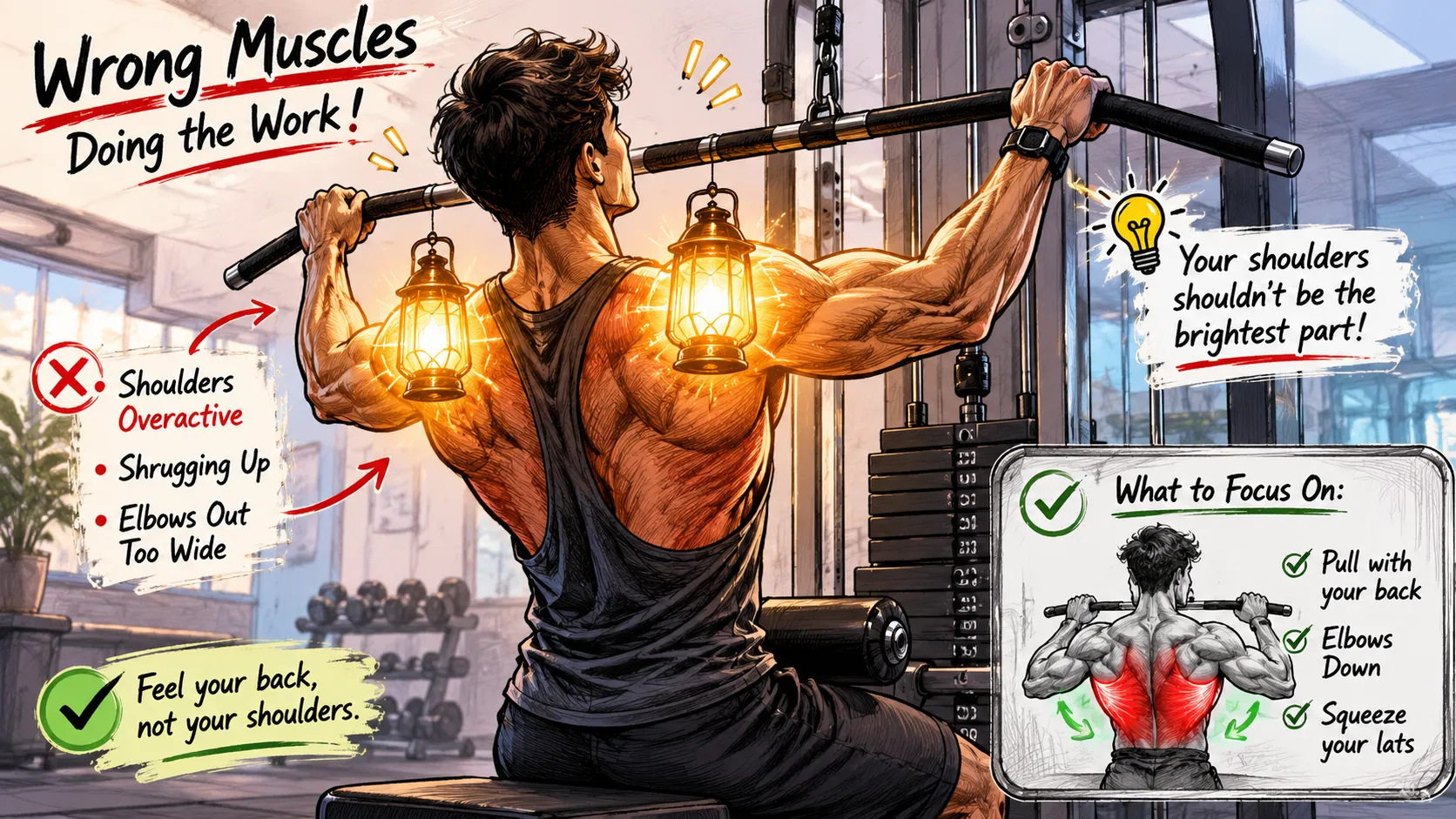
Few gym experiences are more frustrating than finishing a set of lat pulldowns and realizing your shoulders are exhausted while your lats feel like they barely participated. The lat pulldown is one of the most popular exercises for building a wider back, improving pulling strength, and developing upper-body muscle mass. Yet many lifters struggle to feel their lats working, even after years of training. Instead, tension accumulates in the front of the shoulders, rear delts, upper traps, or biceps.
The good news is that feeling lat pulldowns in your shoulders does not automatically mean the exercise is ineffective. The shoulders naturally contribute to vertical pulling movements. The problem arises when they become the dominant movers instead of the lats. In many cases, shoulder compensation develops because of technique issues, poor scapular control, excessive load, mobility limitations, or simply misunderstanding how the movement should feel.
Recent research examining lat pulldown variations suggests that grip changes alone may not dramatically alter lat activation, challenging many traditional gym beliefs. Instead, movement quality, body positioning, and proper muscle recruitment appear to play larger roles in determining where you feel the exercise. Understanding why this happens can help you build a stronger back while reducing unnecessary stress on your shoulders. Let’s break down the most common reasons.
Understanding the Purpose of the Lat Pulldown
Primary Muscles Involved in the Movement
The latissimus dorsi, commonly called the lats, are the largest muscles of the upper body. They originate along the lower spine and pelvis and attach to the upper arm bone. Their primary functions include shoulder extension, adduction, and internal rotation. During a lat pulldown, the lats help pull the upper arm downward and toward the torso.
While the lats are the primary target, they are not the only muscles involved. The movement also recruits the biceps, rear deltoids, teres major, rhomboids, trapezius, and rotator cuff muscles. Think of the exercise as an orchestra. The lats are supposed to be the lead instrument, but many supporting muscles contribute to creating the final movement pattern.
Problems occur when one of the supporting muscles becomes too dominant. If the rear delts or upper traps take over, the exercise starts feeling more like a shoulder movement than a back exercise. This often happens when posture deteriorates, the weight is too heavy, or the shoulders elevate during the pull.
Why the Lats Should Be the Main Driver
A properly executed lat pulldown should create a sensation of tension along the sides of the torso, stretching at the top and contracting as the elbows move downward. The lats work best when the shoulders remain stable and the elbows drive the movement.
Imagine trying to close a pair of heavy curtains. The elbows act as the handles, while the lats provide the pulling force. If you focus exclusively on pulling with your hands, forearms, or shoulders, you reduce the contribution of the muscles you are actually trying to develop.
Many lifters mistakenly think that simply moving the bar down guarantees effective lat activation. In reality, the body will always find the easiest way to complete the task. Without proper technique, stronger shoulder muscles may compensate for weaker or poorly engaged lats.
The Difference Between Lat Engagement and Shoulder Compensation
Signs Your Lats Are Doing the Work
When the lats are properly engaged, several things tend to happen. First, you feel tension building along the outer portion of the back near the armpits. Second, your elbows travel smoothly downward and slightly inward rather than backward. Third, your shoulders remain relatively stable instead of shrugging upward during the pull.
The contraction often feels deep and broad rather than concentrated in a small area. Many lifters describe it as squeezing something beneath the armpits. You may also notice a significant stretch in the lats during the top portion of the movement.
Good lat engagement usually creates a balanced sensation throughout the set. Your biceps assist, but they do not dominate. Your shoulders stabilize, but they do not burn excessively.
Signs Your Shoulders Are Taking Over
Shoulder compensation is often easy to recognize once you know what to look for. Common indicators include:
| Sign | What It May Indicate |
|---|---|
| Shoulders shrug upward during reps | Upper trap dominance |
| Front shoulder discomfort | Poor shoulder mechanics |
| Rear delt fatigue before lat fatigue | Compensation pattern |
| Minimal lat pump after training | Ineffective lat recruitment |
| Excessive arm fatigue | Biceps dominance |
Research examining various pulldown styles found increased posterior deltoid activity in certain positions, particularly when trunk angle and grip changes altered movement mechanics. If your shoulders consistently fatigue before your back, compensation is likely occurring.
Grip Width and Hand Position That Change Muscle Activation
Wide-Grip Pulldowns
The wide-grip pulldown has long been associated with building a wider back. Many lifters believe it dramatically increases lat activation compared to all other grips. Modern EMG research paints a more nuanced picture.
Some studies show slightly greater lat activation with wider grips under specific conditions, especially among beginners. However, the differences are often smaller than gym folklore suggests. A grip that is excessively wide can actually reduce range of motion and place unnecessary stress on the shoulders. For individuals with limited shoulder mobility, an extremely wide grip may encourage shoulder compensation rather than better lat recruitment.
Neutral and Close-Grip Variations
Neutral-grip and shoulder-width pulldowns often feel more comfortable because they allow a more natural shoulder position. Many people can achieve a deeper range of motion while maintaining better elbow mechanics.
These variations frequently help lifters who struggle with shoulder discomfort. The movement tends to feel smoother and allows the elbows to travel closer to the torso, which often improves the mind-muscle connection with the lats.
What Recent Research Says
A 2025 EMG analysis examining seven lat pulldown variations found no statistically significant differences in latissimus dorsi activation across multiple grip widths and forearm positions. The findings suggest that grip variation alone may not dramatically alter lat recruitment. Instead, execution quality appears to be the bigger factor. This means choosing a grip that feels strong, comfortable, and sustainable for your body may be more important than obsessing over minor activation differences.
What Poor Scapular Control Can Do During Pulldowns
The Role of Scapular Depression
The shoulder blades play a major role in vertical pulling movements. Before the elbows begin driving downward, the scapulae should slightly depress and stabilize. This movement creates a stronger foundation for the lats to generate force.
Think of the shoulder blades as the foundation of a building. If the foundation shifts constantly, the entire structure becomes unstable. Poor scapular control forces other muscles to compensate, increasing stress on the shoulders and reducing efficiency.
Many lifters skip this step entirely. They immediately bend their elbows and yank the bar downward. As a result, the lats never fully engage.
Common Scapular Mistakes
One of the most common errors is allowing the shoulders to creep upward toward the ears during every repetition. This pattern shifts tension toward the upper traps and away from the lats.
Another mistake involves excessive shoulder blade retraction. While some retraction occurs naturally, aggressively pinching the shoulder blades together can turn the movement into more of a mid-back exercise.
Proper scapular movement should feel controlled and natural. The shoulder blades move, but they do not dominate the exercise.
Are You Pulling Too Much With Your Arms?
Biceps Dominance During Pulldowns
Many people unknowingly perform lat pulldowns as a biceps exercise. Because the hands are attached to the bar, it is easy to focus entirely on pulling with the arms. The brain naturally recruits muscles that are easiest to feel, and for many lifters, that means the biceps.
This becomes especially common when the weight is too heavy. Instead of allowing the lats to drive the movement, the body relies on elbow flexion to complete each repetition.
A simple question can reveal the problem: if your biceps fail before your back does, are your lats really receiving the intended training stimulus?
How Elbow Path Influences Lat Recruitment
One of the most effective cues is to think about driving the elbows toward your hips rather than pulling the bar to your chest. This shifts attention away from the hands and encourages greater lat involvement.
The elbows should travel down and slightly inward. Excessive backward movement often recruits more rear deltoid and upper-back musculature. Maintaining the correct elbow path can dramatically improve lat sensation without changing the exercise itself.
Mobility Restrictions That Affect Upper-Body Mechanics
Shoulder Mobility Limitations
Limited shoulder flexion can significantly impact pulldown performance. If the arms cannot comfortably reach overhead, the body finds alternative strategies. These compensations often involve shoulder elevation, spinal extension, or altered scapular movement.
As a result, tension shifts away from the lats and into the shoulders. Over time, this pattern can increase discomfort and reduce training effectiveness.
Improving shoulder mobility does not require extreme stretching routines. Consistent overhead mobility drills, controlled arm circles, and targeted warm-ups often produce meaningful improvements.
Thoracic Spine Restrictions
The thoracic spine, located in the upper and middle back, also influences pulldown mechanics. A stiff thoracic spine can make it difficult to maintain proper posture during the exercise.
When upper-back mobility is limited, the shoulders often round forward. This position decreases mechanical efficiency and makes effective lat engagement more difficult.
Maintaining adequate thoracic mobility allows the chest to stay elevated and creates a stronger pulling position.
Small Form Adjustments That Help You Feel Your Lats More
Setup and Body Position
Sometimes the smallest changes produce the biggest improvements. Begin by setting the thigh pads securely and sitting tall. Before initiating the pull, allow the lats to stretch fully overhead.
Maintain a slight backward lean rather than remaining perfectly vertical or excessively reclined. This position often creates a more natural pulling path.
A few practical adjustments include:
- Lower the weight if technique deteriorates.
- Keep the chest proud throughout the set.
- Drive elbows downward rather than backward.
- Avoid shrugging the shoulders.
- Control the eccentric phase.
These changes frequently improve lat engagement almost immediately.
Tempo and Mind-Muscle Connection
Tempo matters more than many people realize. Rushing through repetitions encourages momentum and reduces muscular control. Slowing the movement creates opportunities to consciously recruit the lats.
Spend one to two seconds lowering the bar and two to three seconds returning to the starting position. Focus on the stretch at the top and the contraction at the bottom.
Research and practical experience both suggest that movement quality often matters more than chasing heavier loads.
When Shoulder Discomfort May Need Extra Attention
Normal Muscle Fatigue vs. Pain
There is a significant difference between muscular effort and joint discomfort. Mild fatigue in the shoulders can be normal because they assist in the movement. Sharp pain, pinching sensations, or persistent irritation are different matters entirely.
Pain located deep inside the shoulder joint should never be ignored. While occasional soreness may result from hard training, recurring discomfort often indicates a technique issue, mobility limitation, or underlying injury.
The goal of resistance training is adaptation, not repeated aggravation.
When to Seek Professional Evaluation
If shoulder discomfort persists despite improving technique, reducing load, and addressing mobility restrictions, professional assessment may be appropriate. A qualified physical therapist, sports medicine physician, or experienced rehabilitation specialist can identify issues that may not be obvious during self-assessment.
Warning signs include:
- Persistent pain lasting several weeks.
- Night pain that disrupts sleep.
- Weakness that continues to worsen.
- Clicking or instability accompanied by discomfort.
- Pain that interferes with daily activities.

Corbin Winslow is a 29-year-old American content writer and fitness blogger based in Boise, Idaho. With years of experience researching evidence-based health, training, and nutrition topics, he creates practical, well-sourced articles designed to help readers make informed decisions. As a regular contributor to muscleprogress.xyz, he focuses on translating complex fitness concepts into clear, trustworthy content while drawing from the active lifestyle and outdoor culture of Boise.